Text contribution
An Imagined Conversation with Käthe Sasso
By Nicolas
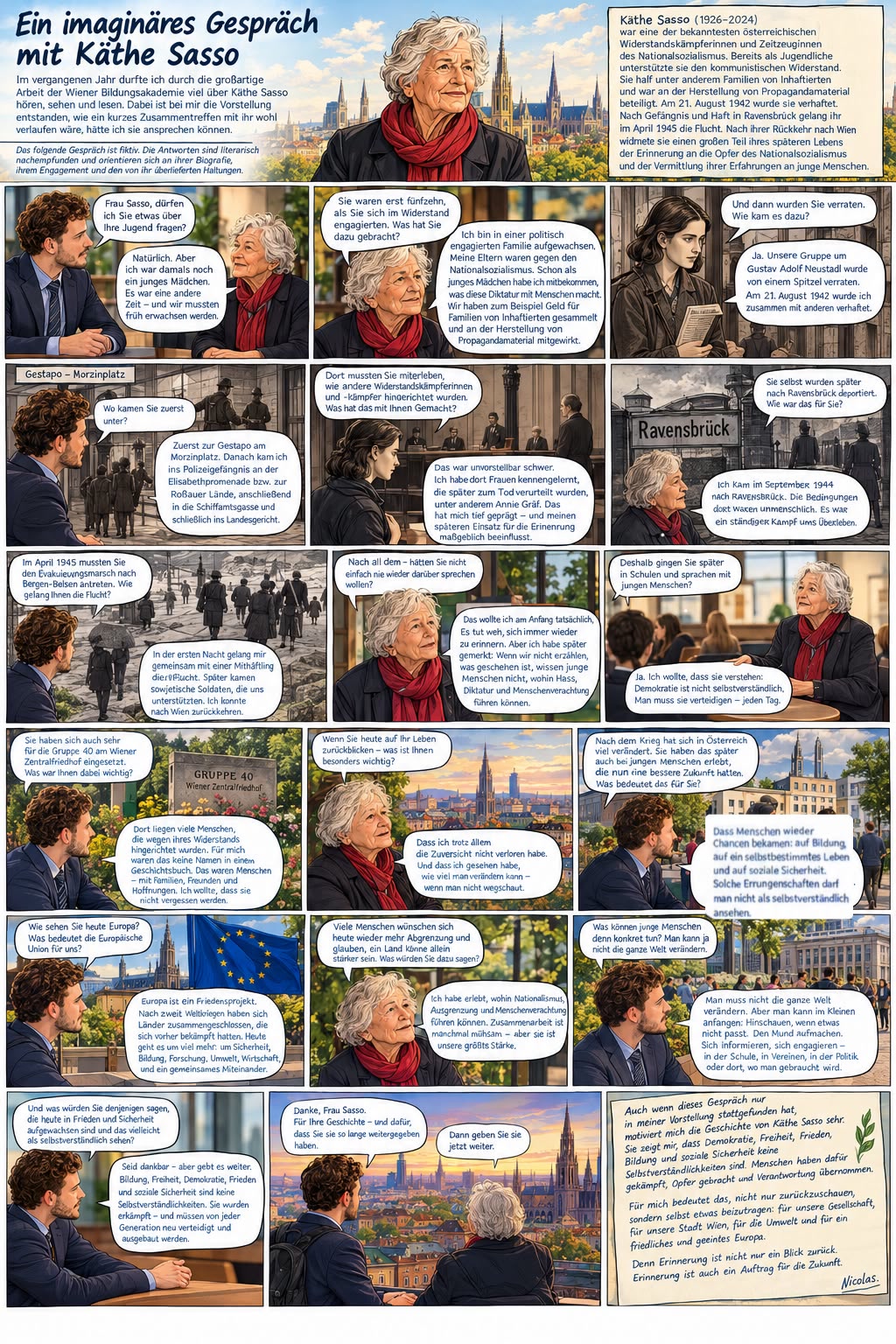
In this illustrated fictional interview, Nicolas imagines what he would have asked Käthe Sasso. He writes her replies as fiction, drawing on her life and her recorded views.
Open the original comic in German at full size
The conversation in words
The interviewer asks Käthe Sasso about her youth. In the imagined reply, she remembers how early she had to grow up. Her parents opposed Nazism. At 15 she helped the resistance, raising money for families of prisoners and working on leaflets.
The group around Gustav Adolf Neustadl was betrayed. Sasso was arrested on 21 August 1942. The comic follows her from the Gestapo headquarters on Morzinplatz through the police prison on the Roßauer Lände and Schiffamtsgasse to the regional court. There she met women who were later executed, including Annie Gräf. Remembering these women shaped her work in later life.
In 1944, she was deported to Ravensbrück concentration camp, where prisoners endured inhumane conditions. In April 1945, she and another prisoner escaped on the first night of a death march toward Bergen-Belsen. She returned to Vienna.
In the conversation, she explains how hard it was at first to speak about what had happened. Later she visited schools to share her experiences, so that young people could understand where hatred, dictatorship and contempt for human life can lead. She campaigned to preserve the memory of people executed for resisting the Nazis who are buried in Group 40 of Vienna’s Central Cemetery.
The interviewer asks about hope, democracy and Europe. The fictional Sasso recalls the importance of education, freedom and social security. She sees European cooperation after two world wars as a project for peace and warns against nationalism and exclusion. She encourages young people to pay attention, stay informed and get involved where they are needed.
At the end, the interviewer thanks her. Sasso asks him to pass the story on. Nicolas closes by saying that imagining the conversation motivates him to contribute himself. For him, remembrance also carries a responsibility for the future.